Before European Settlement
The town of Orland was first settled by Europeans in 1764, on territory of the Penobscot Nation in the Wabanaki Confederacy. Formerly known as "Plantation #2," the early settlement was part of the land granted by Massachusetts to William Bingham between Penobscot and Passamaquoddy Bays, known as the Bingham Purchase of 1786. Orland, located in the Narramissic River and lower Penobscot watersheds, was incorporated as a town in 1800. In 2020, its census was 2221 inhabitants.
Long before European settlers arrived, the area now known as Orland was home to the Wabanaki people, the Indigenous nations who had inhabited the coastal and inland regions of present-day Maine for thousands of years. The land carried their name: the township was known as Alamoosook (also spelled Alamasook), a word of Wabanaki origin, and later as Eastern River, after the waterway that defined its geography. European contact, trade, and eventually colonization profoundly disrupted Wabanaki life across the region. By the time English-speaking settlers began arriving in the 1760s, that disruption was already well underway. The Wabanaki presence shaped the landscape -- in place names, travel routes, and fishing grounds -- that the newcomers found and built upon.
The First Settlers
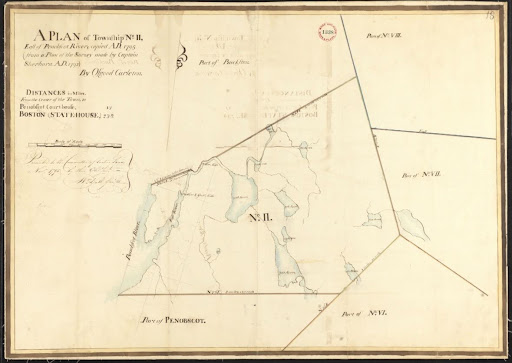
In 1762, the township was granted to David Marsh and associates, setting the legal framework for settlement. The first settler to arrive was Joseph Gross, who came in 1764 from Fort Pownal (now Fort Point) and established himself on a lot along the Castine Road, when the area was still known as Plantation No. 2. Local tradition holds that the name "Orland" derives from "Oar-land," after an oar Gross found on the shore upon his arrival -- a story that may be apocryphal but has persisted across generations.
Gross's brother Ebenezer followed in 1765, settling at what became Gross Point. Samuel Craige arrived the next year, just south of Joseph Gross, and Joseph Viles came from Milton, Massachusetts in 1767, building the first framed house in the plantation a decade later.
Zachariah Gross, son of Joseph, was the first white male child born in Orland, in 1766. The plantation's first recorded death came in 1770, when Samuel Cushing drowned in the Eastern River and was buried in the Old Burying Ground.
Growing the Community
Between 1767 and 1780, a wave of settlers arrived from Boston and the surrounding area, taking up lots on the east side of the Eastern River. Among them were John Hancock, Samuel Keyes, Samuel Soper, Calvin Turner, Asa Turner, and Humphrey Holt. In 1781, the Harriman brothers -- Ezekiel, Peter, and Asa -- relocated from neighboring Plantation No. 1, which would become Bucksport.
Not everyone settled near the water. In 1773, Michael Davis, described as an old hunter from Concord, Massachusetts, took up a lot on a ridge three miles from any other settler and lived in isolation until neighbors gradually filled in around him. Jacob Sherburne arrived from Hampton, New Hampshire in 1791 and settled at what became Sherburne's Point.
By 1799, the plantation had 70 taxable residents. Real estate was valued at just over $24,000 and personal property at just over $15,000. The following year, 1800, Orland was incorporated as a town.
Mills, Ships, and Early Industry
The settlement developed a modest industrial life early on. James Ginn came from Brewer and operated a mill, building one brig and two schooners during his tenure before moving to Bucksport around 1797. The mill eventually passed to John Lee of Castine, who ran a substantial operation, succeeded around 1816 by his nephew Joseph Lee.
Shipbuilding became a defining industry. Samuel Keyes built the first vessel in town at the Upper Falls. Samuel P. Brown, originally of Blue Hill, was a particularly energetic presence -- he built many of the houses in Orland Village, constructed ships and brigs, developed several local industries, and eventually left for Washington, D.C. to serve as a Navy Agent. John Buck, his son John A. Buck, Aaron P. Emerson, Henry Partridge, and George Partridge carried on the shipbuilding tradition in later years.
By the 19th century, Orland's industrial footprint had grown considerably. In addition to the shipyard, the town supported a grist mill, six sawmills, a lumber mill, a brickyard, and a woolen factory -- a remarkable range of activity for a small rural community.
Craig Brook National Fish Hatchery
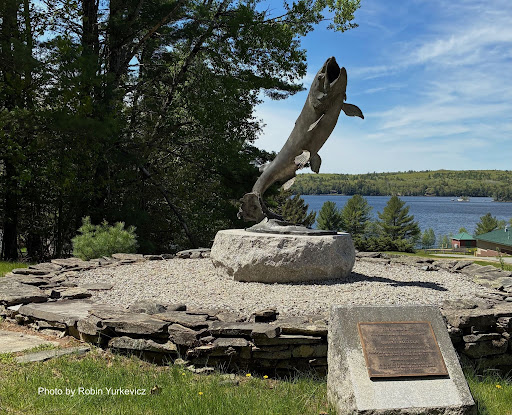
One of Orland's most enduring contributions to American history sits quietly in East Orland on the shore of Alamoosook Lake. In 1871, biologist Charles Atkins, alarmed by declining Atlantic salmon populations, established Craig Brook Station on the site of a former sawmill. In 1889, it became the first federal fish hatchery in the United States to raise sea-run Atlantic salmon -- a distinction it still holds. Today the facility operates as Craig Brook National Fish Hatchery, managed by the U.S. Fish and Wildlife Service, and remains active in the conservation of endangered Atlantic salmon populations in Maine's coastal rivers. The hatchery is open to visitors and includes a museum and nature trails connecting Alamoosook Lake to Craig Pond.
Civic Leaders
Orland's early civic life centered on a handful of prominent figures. Joseph Lee became the town's first clerk and chairman of its first board of selectmen, the most influential man in town at incorporation, and came from a distinguished Virginia family. John Hancock, first town treasurer and cousin to Governor Hancock, and figures like Samuel Keyes, Abraham Ginn, and Moses Trussell shaped the new town's public life. Trussell went on to serve in the Massachusetts Legislature. When Maine drafted its constitution in Portland in 1819, Orland sent Horatio Mason to represent it.
The Civil War
Orland sent men to serve in the Civil War, and the conflict touched the town's professional life as well -- several of the physicians who practiced here during and after the war had served as army surgeons. The full record of Orland's participation in the war is documented in Orland Men of the Civil War, available through the Orland Historical Society.
Doctors and Medical Care
Medical care in early Orland was provided by a rotating cast of practitioners, few of whom stayed long. Dr. John Herbert, mentioned among the earliest settlers, lived on the Castine Road and may have practiced medicine alongside his work as a schoolmaster. The Henderson brothers, Jonathan and William, were early physicians. Dr. Nathan Emerson was present by 1850 and later took a government clerk's appointment in Washington. Several others -- Drs. Eastman, Gray, and Alpheus Page -- passed through briefly before moving on to Bucksport or elsewhere.
Robert T. Osgood combined business with dentistry and some medical practice. Dr. John Wardwell practiced both dentistry and medicine at East Orland. Dr. George A. Wheeler was here before the Civil War, served as an army surgeon, and later settled in Castine. A succession of physicians followed through the latter half of the century: Dr. Willard C. Collins departed for Bucksport in 1866; Dr. F. H. Chase, an army lieutenant, came after the war and left for Bangor in 1882; Dr. Frank P. Perry succeeded him. Dr. R. H. Croxford arrived in 1891 and left for Brewer in 1905, when he was succeeded by Dr. C. W. Brown, a University of Maine graduate who had also trained in New York.
Learn More

For a richer account of Orland's history, the town's bicentennial volume is available to read online: Best Remembered: Orland, Maine 1800-2000. As its editors wrote, the book "offers tales to delight and history to enlighten the willing reader" -- and an open invitation to future historians to continue the work.